

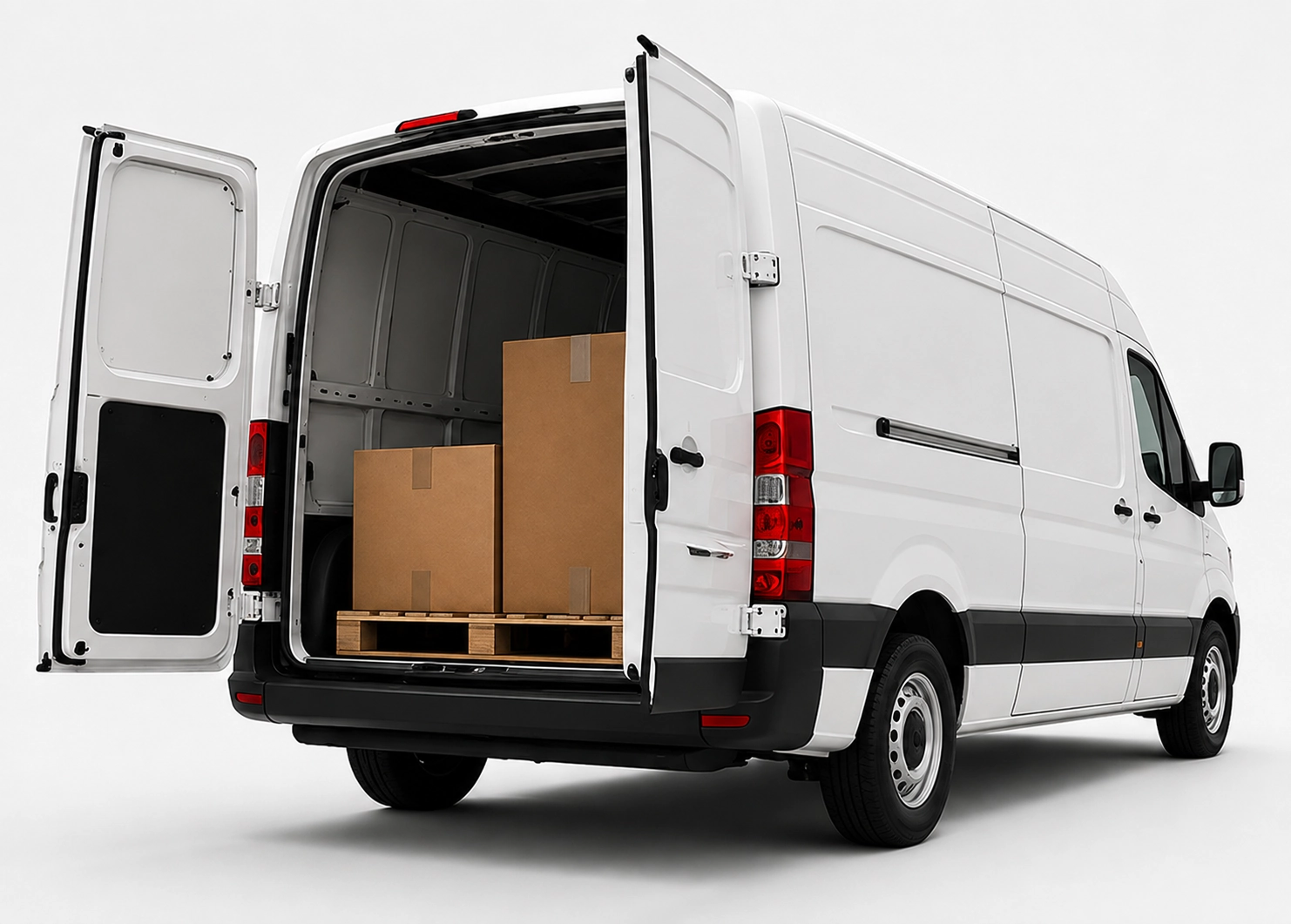
No detours.
Even overnight.
x25pronto Austria carries approved goods shipments by car, van or Van XL personally and without unnecessary transhipment. Direct and overnight trips can be booked Monday to Sunday – subject to availability in the booking calendar.
Calculating shipping savings: practical SME case examples
Three practical examples show how SMEs can cut shipping costs. Step‑by‑step calculations, cost drivers and immediate actions for better margins.
Quick answer
This guide gives three practical cases showing how SMEs can reduce shipping costs. You get step‑by‑step calculations for e‑commerce, manufacturing and spare parts. Learn which cost drivers to target and whether direct courier or standard express is more economical.
Why concrete examples matter
Percentages alone rarely help. SMEs differ by product value, package size and delivery windows. A worked example makes cost structure tangible. You then spot levers such as consolidation, timing choices and route alternatives.
Base formula: a simple cost model
Use this: Total shipping cost = transport price + packaging + handling + returns effort + admin. Divide by shipments in the period for per‑item cost. Separate fixed and variable parts. Variable costs usually fall with volume consolidation.
Case 1 — E‑commerce: small retailer with high returns
Situation: 1,000 orders/month, avg item value 45 EUR, returns 20%. Current cost per shipment: shipping 6.50 EUR, packaging 0.60 EUR, handling 1.20 EUR. Monthly shipping cost: 8,300 EUR. Returns cost (reverse, inspection, repack): ~3.60 EUR/return → 720 returns = 2,592 EUR. Total 10,892 EUR, per‑item 10.89 EUR. Levers: right‑sized packaging (0.40 EUR), reduce returns via better photos/size info (from 20% to 12%), and switch to consolidated pickups. If shipping price falls to 5.80 EUR via consolidation and returns drop, monthly savings ~2,140 EUR (~20%).
Case 2 — Manufacturing: heavy parts with shorter cycles
Situation: 120 deliveries/month, avg weight 14 kg, high value, often urgent. Current cost per shipment: freight/pallet 28 EUR, packaging 4.50 EUR, handling 8 EUR (special packing). Total per delivery 40.50 EUR → monthly 4,860 EUR. Levers: consolidate with JIT windows, use direct courier only for true emergencies, optimize packing volume. If 25% of orders are consolidated or shifted to regular day runs, you save ~303 EUR/month. Reusable packaging gives another 10% over a year. Total potential 15–20%.
Case 3 — Spare parts: high urgency, low volumes
Situation: 60 emergency orders/month, avg value 220 EUR, fast response required. Cost per individual courier run: 55 EUR including drive and handling. Express parcel alternative: 18 EUR. All‑courier monthly cost: 3,300 EUR. Levers: limit couriers to truly critical cases, pre‑position stock regionally, combine multiple customers on one tour. If 40% move to express parcel, you save (0.4*60)*(55‑18)=894 EUR/month. Combined with prepositioning, potential 20–30%.
Next steps: checklist to run your calculation
1) Collect 12 months of shipping data. 2) Split fixed and variable costs. 3) Compute per‑channel per‑item costs. 4) Pilot in one region or product group. 5) Track returns, lead time and customer impact. 6) Scale only when savings are proven. Use cost centers to show savings clearly.
Frequently asked questions
How quickly will I see shipping savings?
Some changes show results within a month. Packaging investments and process changes take longer. Measure early and compare to the prior period.
Is an external courier worth it for low volumes?
Yes for urgent single shipments. For recurring routes, negotiate with parcel services or consolidate tours for lower unit cost.
How do I include returns in my calculation?
Count direct costs (transport, inspection, rework) and indirect costs (customer service, inventory). Allocate across sold units.
Which metrics should I review regularly?
Volume per channel, per‑item cost, return rate, lead times and cost by urgency class.